
Personal project
DSDS Project: survivor detection with UWB radar and AI
UWB signal-processing model to detect breathing and heartbeat of people trapped under rubble, combining classic DSP with deep learning.
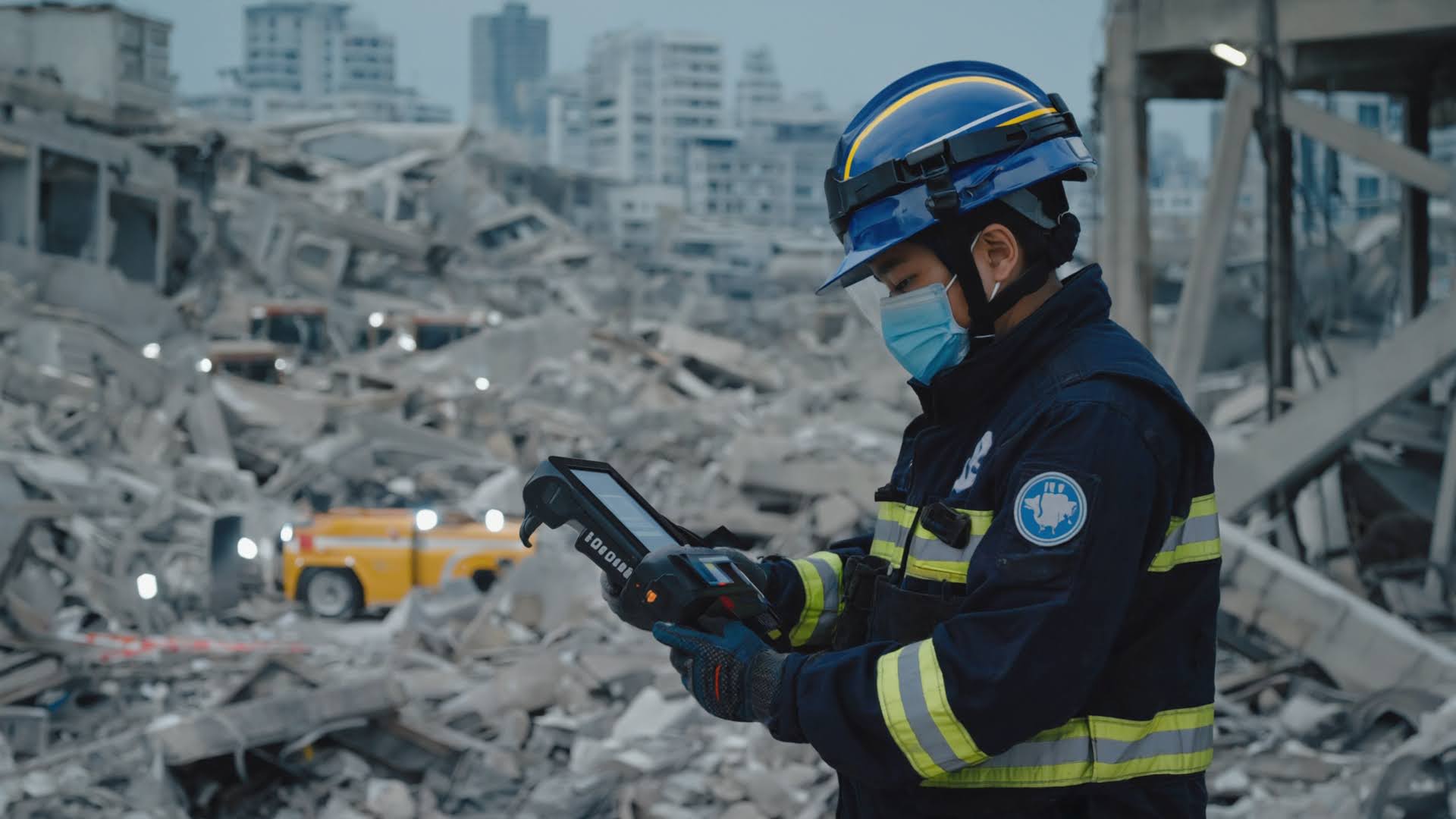
As part of my Disaster Survivor Detection Systems (DSDS) project, I'm developing a UWB signal-processing model to detect the breathing and heartbeat of people trapped under rubble after a natural disaster, using open-source and synthetic data.
The challenge: extracting imperceptible signs of life
The mission is to identify a human heartbeat within complex ultra-wideband (UWB) radar signals. These signals capture tiny body movements that reflect both breathing and heartbeat. Distinguishing the cardiac pulse from background noise and other motion is a challenge that demands advanced signal processing and machine-learning techniques.
Step 1: from raw radar data to motion phase
The first key step is transforming the raw radar data (I and Q components) into a representation that directly reflects motion.
Building the complex signal: we combine the two raw radar streams (I and Q) to form a complex signal. It's similar to merging X and Y coordinates to get a 'position' or state over time.
Extracting the phase signal: from this complex signal, we derive a phase signal that acts as a direct representation of the tiny displacements the radar detects on the target. This signal is the foundation for all downstream analysis.
Step 2: isolating the heartbeat through smart filtering
Once we have the general phase signal, it contains breathing components (slower, larger movements), heartbeat components (faster, subtler) and various forms of noise. To focus specifically on the heartbeat we apply a band-pass filter: it works like a sieve that only lets human-heartbeat frequencies through (between 0.8 Hz and 2.5 Hz, equivalent to 48–150 bpm), blocking lower breathing frequencies and most noise. The result is a much cleaner cardiac signal.
Step 3: measuring the heartbeat — the search for frequencies
With the heartbeat signal isolated, the next goal was to estimate its frequency. We explored two signal-processing approaches:
1. Spectral analysis (Short-Time Fourier Transform - STFT): we segment the signal into small time windows and compute the frequency spectrum, analogous to identifying the musical notes present in each short fragment of a song. Then we try to locate the highest peak within the expected heartbeat range as its dominant frequency.
2. Autocorrelation analysis: this method looks for repetitive patterns within the signal. Autocorrelation tells us how often the wave resembles itself. That repetition time represents the heartbeat period, and its inverse gives the frequency.
Step 4: setting the stage for AI — MFCCs
Although classic DSP methods provide valuable estimates, the complexity of the radar environment and the subtlety of the heartbeat suggest a smarter approach. Enter machine learning.
For an AI to understand our signals, we must transform them into a format it can process. We introduce Mel-Frequency Cepstral Coefficients (MFCC): features widely used in voice and music processing. They're a kind of compact acoustic fingerprint of sound, capturing how the human ear perceives different frequencies. For the heartbeat, MFCCs provide a unique numerical representation of its spectral characteristics in each time window.
The result: we successfully extracted a data matrix (for example, 601 time windows by 13 MFCC features). Each row is a vector that describes the heartbeat (or its absence) at a given instant.
The horizon: heartbeat classification with deep learning
With MFCCs extracted, the stage is set to train machine-learning models. The main goal is binary classification: determining the presence or absence of a heartbeat within a given time window. This is a direct application for survivor detection.
To tackle it, we're designing a model based on Recurrent Neural Networks (RNN), specifically Long Short-Term Memory (LSTM) networks. LSTMs are especially well-suited to sequential data like our MFCCs because they can remember long-range dependencies — crucial for identifying the periodicity of a heartbeat.
Although training on the full dataset (over 1,100 files totaling 5.3 GB) is computationally intensive, we've established the methodology: systematic MFCC and label extraction from each file; data preparation and scaling for the neural network; building and training an LSTM model to classify heartbeat presence.
Conclusion and next steps
We've made significant progress: from raw radar signals to advanced features ready for machine learning. The transition from classic DSP to MFCCs and LSTMs is a qualitative leap.
The next critical step is final implementation and large-scale training of the deep-learning model. With a robust classifier able to identify heartbeat presence, we aim to offer a vital tool for rescue teams, letting them locate lives in critical situations where every second counts.
References
MobiVital Dataset: the data used is based on the MobiVital-dataset, a comprehensive dataset for mobile vital-sign detection — https://zenodo.org/records/15022885 and https://github.com/nesl/MobiVital-dataset.
The work is inspired by research in ubiquitous computing and mobile health from academics like Mani Srivastava, Distinguished Professor & Vice Chair at UCLA and Amazon Scholar (https://www.linkedin.com/in/msrivastava/).
I hope Vikash Rungta (https://www.linkedin.com/in/vrungta/) and Navin Rungta (https://www.linkedin.com/in/nkr102/), of DSP - Digital Signal Processing, get to read it. This is the first step of a project we want to strengthen with more data and integrate into AI-equipped drone hardware.